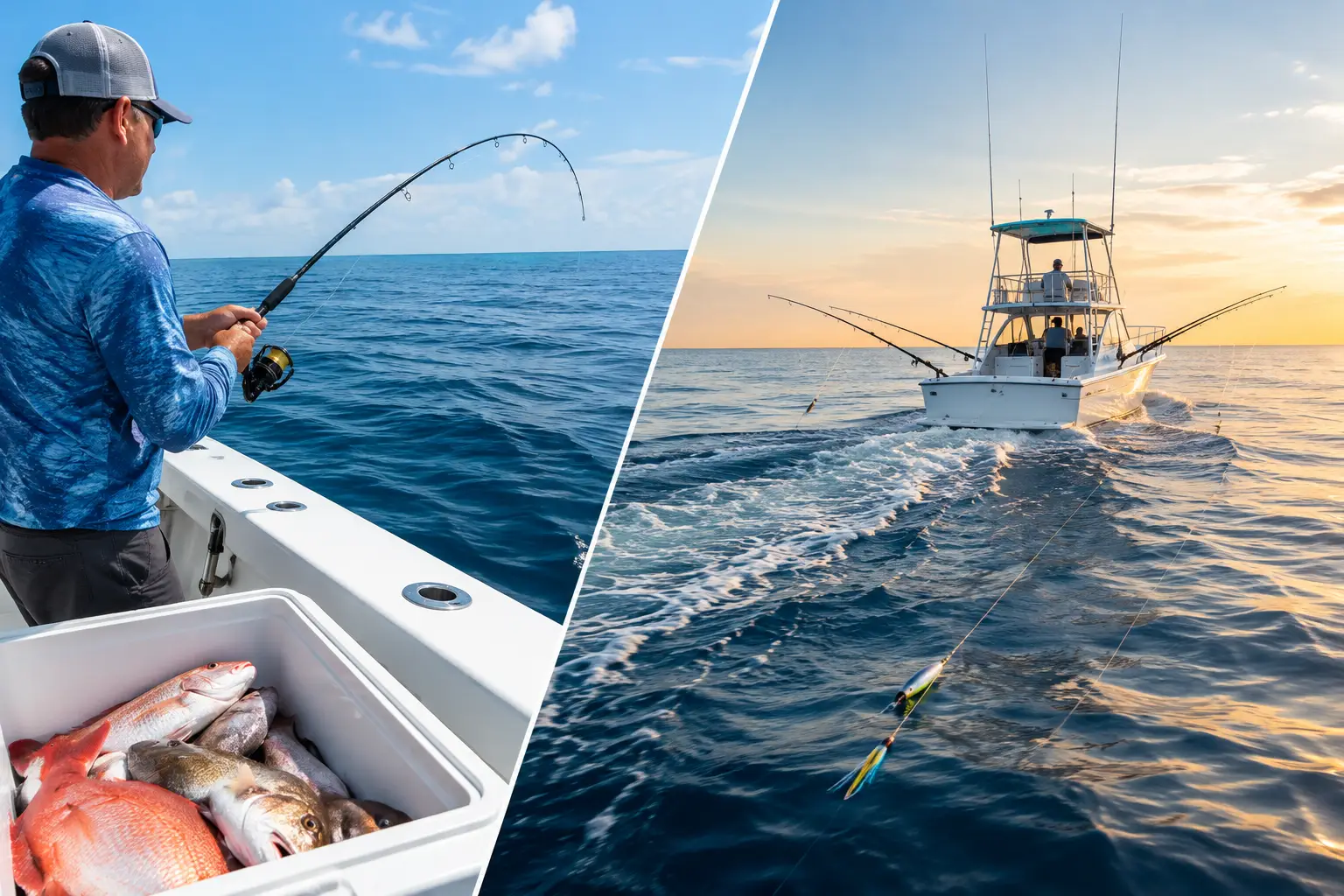
Your first strike can tell you exactly what kind of day you booked. With bottom fishing versus trolling trips, one crew may be dropping baits to a reef and feeling every tap through the rod. Another may be watching a spread trail behind the boat, waiting for a kingfish, tuna, or billfish to crash it. Both can be outstanding charter days. They just ask for different things from the boat, the water, and your group.
If you are choosing between them, start with the fish you want to catch. Then consider how your crew likes to fish, how far offshore you are willing to run, and whether you want steady hands-on action or the suspense of a big fish finding the spread.
Bottom Fishing Versus Trolling Trips at a Glance
Bottom fishing puts your bait or lure near structure on or near the seafloor: reefs, wrecks, ledges, rock piles, and hard-bottom areas. The boat may anchor, drift slowly, or use positioning equipment to hold near the target. You are actively working a rod, watching for bites, setting hooks, and fighting fish that often head straight back to cover.
Trolling means fishing moving baits or lures while the boat travels. The captain may pull a spread along a beach, over open water, around a rip, or above offshore structure. Rather than casting and retrieving all day, anglers watch rods, teasers, birds, bait, and the water behind the boat until a fish takes off with one of the offerings.
Neither style is automatically easier or better. Bottom fishing often gives a group more frequent chances to participate. Trolling can produce fewer bites, but those bites may be spectacular and involve fast, powerful fish. Your best choice depends on the day you want, not just the biggest species on the local catch list.
What You Can Catch on Each Trip
Bottom fishing is about structure-oriented fish
Bottom fishing is a natural fit for fish that live, feed, or travel close to reefs and the seafloor. Depending on the region and regulations, that can mean red snapper, grouper, amberjack, triggerfish, sea bass, tilefish, halibut, rockfish, flounder, sheepshead, and a long list of reef species.
The appeal is variety. On a productive reef, you may not know exactly what is about to eat your bait. A first-timer can catch a hard-pulling fish within minutes, while an experienced angler can focus on presenting a bait precisely around the right piece of structure. Bottom fishing can also put dinner on the table when the fish are in season and legal to keep.
That said, it is not always a nonstop bite. Current, tide, bait availability, water clarity, and how crowded a piece of structure is can change the action fast. Some species are also tightly regulated, so a captain may release fish that are out of season, undersized, oversized, or otherwise protected.
Trolling targets fish that roam
Trolling is built for predators that cover water. Common targets include king mackerel, mahi mahi, wahoo, tuna, striped bass, salmon, sailfish, marlin, and sometimes cobia or tarpon in the right setting. The exact lineup changes sharply by coast, season, and distance from shore.
A trolling spread lets the boat search for fish rather than wait for fish to find one spot. That is a huge advantage when bait is scattered or when migratory fish are moving through a broad area. The visual side of trolling is part of the draw: a tuna piling onto a lure, a sailfish appearing in the wake, or a kingfish ripping line off the reel gets everyone looking in the same direction.
The trade-off is participation. There may be long stretches of scanning the water and waiting. When a rod goes off, things can get busy quickly, but usually one angler fights the fish at a time. On a larger group trip, make sure everyone understands that the action may come in bursts rather than evenly throughout the day.
How the Fishing Feels on the Boat
Bottom fishing is more tactile. You will usually hold the rod, feel the sinker hit bottom, take up slack, and learn the difference between a small peck and a real bite. When a grouper or snapper eats close to structure, the first few seconds matter. You need to lift, reel, and keep the fish from reaching its home turf.
That hands-on rhythm makes bottom fishing a strong choice for families, mixed-skill groups, and anglers who want each person to stay engaged. Even when the target species is challenging, the basic idea is easy to grasp: get down, stay connected to the bottom, and be ready.
Trolling has a different kind of anticipation. The boat is covering ground, the crew is watching conditions, and the strike can be sudden. You may see a fish slash at a lure, hear drag start screaming, or watch a rod bury toward the water. Once hooked up, the fight can be long and physical, especially offshore.
Trolling also rewards patience. If your dream is a tuna, wahoo, sailfish, or marlin, you are accepting that the day may involve searching. That does not make it passive. Pay attention, ask what the crew is watching for, and be ready when it is your turn in the chair or on the rod.
Distance, Sea Conditions, and Trip Length
Do not assume bottom fishing always means calm, close-to-shore water or that trolling always means a long offshore run. Nearshore trolling for kingfish or striped bass may happen within sight of land. Deep-drop bottom fishing for tilefish can require a serious run and very deep water.
Still, the general pattern holds. Inshore and nearshore bottom trips often make sense for shorter charters and crews with younger anglers. Reef and wreck fishing can offer plenty of action without committing the whole day to travel. Offshore bottom fishing and offshore trolling usually need more time because the boat must reach productive grounds before lines go in.
Sea conditions matter, too. A trolling boat is moving for much of the trip, which can feel better to some anglers but harder to others. Bottom fishing may involve drifting or sitting over a spot, and that can be uncomfortable if the boat is rocking in a swell. If anyone in your group is concerned about motion sickness, say so before booking. A captain can help point you toward a trip style and departure plan that makes sense for the forecast and your crew.
Choose Bottom Fishing If Your Crew Wants More Rod Time
Bottom fishing is often the better call when your group wants frequent chances, a more active role, and a good shot at a mixed bag of species. It is especially well suited to first-timers who want to learn the feel of a bite and keep a rod in hand.
Choose it if you are planning around reef fish, wreck fish, halibut, or other bottom-oriented species. It also fits anglers who would rather work one productive zone thoroughly than spend the day traveling in search of a roaming fish.
Ask before booking whether the trip will anchor, drift, fish natural bottom, or target wrecks. Those details affect the experience. Also ask what species are expected at that time of year, what may be kept, and whether the boat has a backup plan if current or weather makes a favorite spot unfishable.
Choose Trolling If You Are Chasing Pelagics or a Big-Moment Bite
Trolling makes the most sense when the fish on your wish list are moving fast and covering open water. If you are after mahi mahi, tuna, wahoo, salmon, king mackerel, sailfish, or marlin, it is often the core method or part of a mixed offshore day.
It is also a great fit for anglers who enjoy the hunt as much as the catch. Looking for birds, weed lines, bait schools, temperature breaks, and surface activity is real fishing, even before a rod bends. The payoff can be a fish that runs hard, jumps, or changes the mood of the whole boat in seconds.
Before you commit, ask how much of the trip is likely to be spent running, what the usual target species are, and whether the charter can switch to bottom fishing if pelagic action is slow. A flexible plan can be valuable, but do not expect every boat or every season to support both approaches equally well.
The Best Answer May Be a Combination Trip
On many coastal charters, you do not have to choose only one method. A captain might troll during the run offshore, stop on productive bottom, then troll again on the way home. This is a smart option for a group with different goals: one angler wants a snapper for dinner, another wants to hear a reel scream for a kingfish or tuna.
Combination trips work best when the fishing grounds line up and the trip is long enough to avoid rushing. Tell the captain what matters most to your group. If catching a specific species is the priority, keep the plan focused. If you are after a fun day with variety, a mixed approach can keep rods busy and give the crew more ways to find your next unreel catch.
When you are ready to book, lead with the fish you want and the experience you want around it. A reef bite with rods bending all morning and a trolling strike from a fast-moving pelagic are both worth the trip - just make sure you choose the day you will be excited to fish from the first cast to the ride home.